 为空压机出口空气流量,
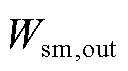 为供应歧管出口空气流量,其值等于进入电堆阴极的入口流量,
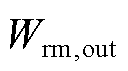 为返回歧管的出口空气流量,
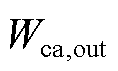 为阴极出口流量,
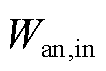 和
和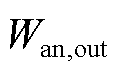 分别为阳极入口氢气流量和出口氢气流量,
 、
、 、
、 、
、 、
、 、
、 分别为海拔H处的大气压力、大气温度、大气密度、空气粘度、声速以及重力加速度。
摘要 针对变海拔复杂工况下燃料电池发电系统高空供氧不足、系统效率下降等问题,基于构建的变高度离心式空压机动态模型与质子交换膜燃料电池阴极供气回路机理模型,该文提出了一种粒子群算法空压机动态压比优化策略,将建立的系统效率模型作为优化目标函数,对空压机及其所在的阴极供气系统进行最优压比计算。该策略在宽工况范围内相比恒定增压比供气方案,系统效率有不同程度提升。设计气压、流量PID双闭环控制结构抑制海拔及负载突变扰动。仿真结果显示,所提最优压比运行策略在复杂工作环境和动态负载需求下,能始终保持最大值输出,且性能优于其他方案,为燃料电池发电系统在变海拔工况下的稳定运行提供了有效解决方案。
关键词:质子交换膜燃料电池 粒子群优化算法 系统效率 阴极供气系统 比例-积分-微分
质子交换膜燃料电池(Proton Exchange Membrane Fuel Cell, PEMFC)是解决主流锂电池无人机续航能力严重不足、低温适应性差等问题的有效技术途径,在连续长距离作业和低温条件下具有不可替代性[1]。系统效率作为发展长航时氢燃料电池无人机的关键技术指标,与其所处环境参数密切相关[2]。随着海拔高度升高,大气环境参数及空压机雷诺数减小,空压机扩压器中的能量损失加剧,工作特性区间偏移,同等负载条件下,需要运行于更大压比、更高转速工况以满足空气流量需求。此时空压机消耗功率增加,工作效率下降,最终导致发电系统整体效率降低[3]。因此,在PEMFC的变高度运行过程中,及时根据负载变化对阴极供给流量、压力做出调整,最大程度地降低空压机的寄生功耗,对提升PEMFC系统的输出性能和运行稳定性具有重要意义。
目前对PEMFC空气供应系统的优化研究,多聚焦于地面环境变负载工况下过氧比与输出功率的稳态优化[4-5],优化指标侧重系统峰值性能而忽略长期性能的表现,对变海拔动态特性的压力优化研究仍存在不足。近年来,研究人员注意到高空运行环境下空压机对燃料电池输出性能优化的重要性,并开展了相关研究。文献[6]指出,随着海拔升高,降低的大气压力和温度会大幅增加PEMFC供气系统模型误差。为提高模型适应性,文献[7-8]研究了不同高度空压机的工作特性,文献[7]验证了过氧比和压力联合优化在变海拔场景的正向作用。针对高海拔环境下PEMFC发电系统存在的问题,文献[9]通过极值搜索算法在线优化过氧比,实现了PEMFC系统在连续变高度扰动下最大净功率输出。文献[10-11]通过离线构建0~4 000 m海拔区间内最优过氧比轨迹,保证了PEMFC系统在变高度条件下的高效率运行。但上述研究的核心关注点仍集中于最优过氧比。同时,气压-流量调控是实现PEMFC系统效率优化时需要解决的另一个重要问题,现有研究已形成包含单一参数控制、联合控制及解耦控制的多层次策略体系,典型方法涵盖经典比例积分微分(Proportional Integral Derivative, PID)控制[12]、前馈控制[13]、滑模控制[14]、自适应控制[15]、耦合算法控制[16]、机器学习[17]及神经网络智能控制[18]等先进算法。这些方法在地面环境稳态工况下均表现出良好的控制精度,但在变海拔强扰动条件下的动态鲁棒性仍需进一步验证。
粒子群优化(Particle Swarm Optimization, PSO)算法在计算效率、寻优精度及工程实用性等方面具有优势,针对变海拔工况下PEMFC空气供应系统的优化需求,本文提出基于PSO算法的空压机动态压比优化策略:将多参数耦合的系统效率模型作为优化目标函数,实现全局效率最优;同时,通过气压-流量双闭环PID控制架构动态补偿偏差,确保电堆阴极侧气体参数快速收敛至最优工作点。研究可直接减少系统能量损耗,提升系统对负载变化的适应性,为PEMFC无人机在宽工况条件下运行可靠性和续航能力的提升提供了一种解决思路。
PEMFC发电系统主要由电堆、阴极供气子系统、阳极供气子系统、水热管理子系统、DC-DC变换器及控制器组成。PEMFC气体供应系统结构阴、阳极气体流动路径如图1所示,为空压机出口空气流量,为供应歧管出口空气流量,其值等于进入电堆阴极的入口流量,为返回歧管的出口空气流量,为阴极出口流量,和分别为阳极入口氢气流量和出口氢气流量,、、、、、分别为海拔H处的大气压力、大气温度、大气密度、空气粘度、声速以及重力加速度。
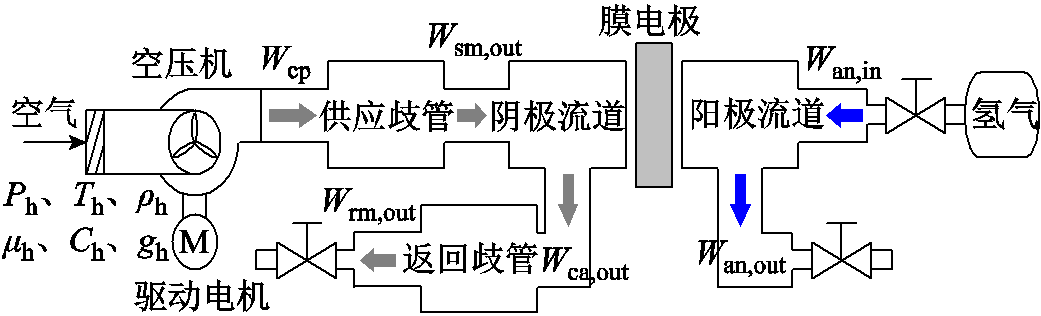
图1 PEMFC气体供应系统结构
Fig.1 Structure of PEMFC gas supply system
电池单体理想开路电压约1.23 V,实际输出电压为理想电动势与极化现象产生的损失过电动势的差值,一般在0.7 V左右[19],即
 (1)
(1)
式中,N为电池串联单体个数; 为能斯特电压;
 为活化损失电压;
 为欧姆损失电压;
 为浓差损失电压。设计的电堆参数见表1。
本文建立了适用于11 000 m以下标准大气模型,对离心式空压机入口空气参数进行修正,提高模型精确度,相关参数计算方法如下。
海拔H处大气温度 参考值计算式为
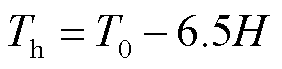 (2)
(2)
表1 电堆相关参数
Tab.1 Relevant parameters of the fuel cell
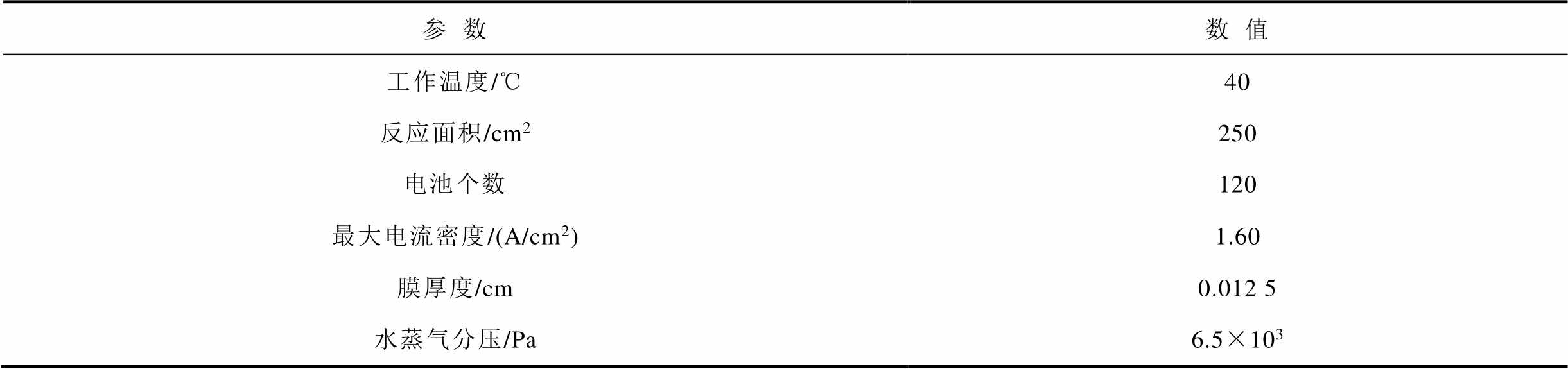
参数数值 工作温度/℃40 反应面积/cm2250 电池个数120 最大电流密度/(A/cm2)1.60 膜厚度/cm0.012 5 水蒸气分压/Pa6.5×103
式中,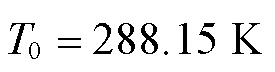 。
。
大气压力 参考值的计算表达式为
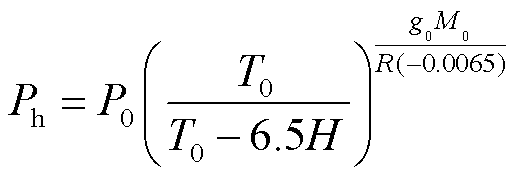 (3)
(3)
式中, 为海平面处标准大气压力;
 为海平面处重力加速度;
 为海平面处空气平均相对分子质量;
 为通用气体常数。
大气密度 参考值的计算表达式为
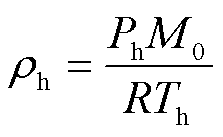 (4)
(4)
空压机在等熵压缩过程中的出口气体压力与入口气压、温度的关系为[8]
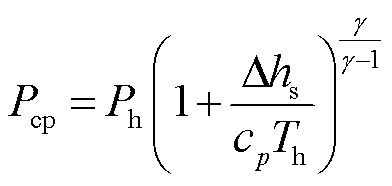 (5)
(5)
式中, 为空压机输出气压;
 为比定压热容;
 为恒压空气比热容与恒容空气比热容的比值;
 为等熵压缩过程中的实际焓增加量,其数值等于压缩空气时的滞止焓增量减去入射损失、摩擦损失及其他损失引起的焓增量,即
 (6)
(6)
式中, 为滞止焓的总增加量;
 为入射损失引起的焓增量;
 为摩擦损失引起的焓增量;
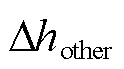 为其他损失引起的焓增量。
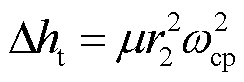
滞止焓的总增加量 的表达式为
的表达式为
 (7)
(7)
 (8)
(8)
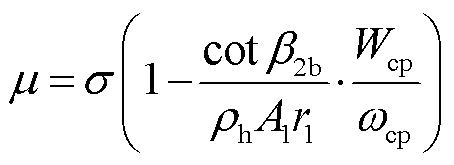
式中, 为经验系数;
 为叶轮半径;
 为空压机转速;
 为滑移因子;
 为转子叶片出口角度;
 为叶轮眼处空气流通面积;
 为叶轮平均引导半径。
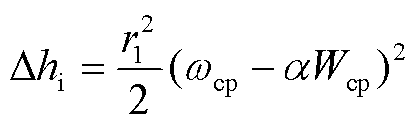
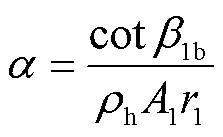
入射损失引起的焓增量的表达式为
 (9)
(9)
 (10)
(10)
式中, 为经验系数;
 为转子叶片入口角度。
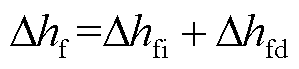
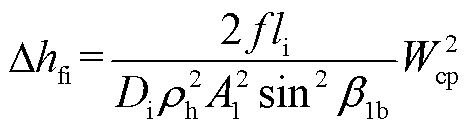
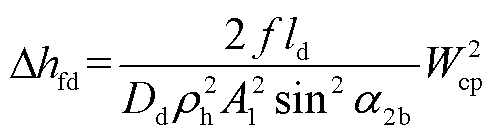
摩擦损失引起的焓增量的表达式为
 (11)
(11)
 (12)
(12)
 (13)
(13)
式中, 为叶轮摩擦损失;
 为扩散器摩擦损失;
 为流体摩擦阻力系数;
 为叶轮平均管道长度;
 为扩散器平均管道长度;
 为叶轮处平均液压管道直径;
 为扩散器处平均液压管道直径;
 为扩散器的入口角度。
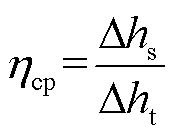
空压机工作效率 计算式为
计算式为
 (14)
(14)
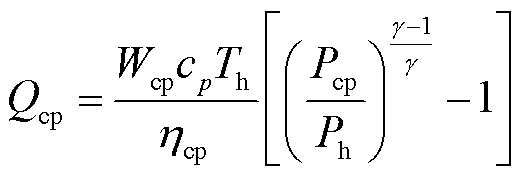
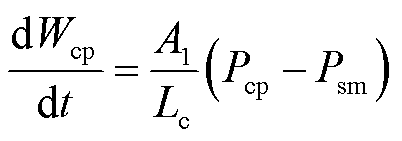
空压机消耗功率 及出口流量计算式为
 (15)
(15)
 (16)
(16)
式中, 为气体传输管道长度;
 为供应歧管内空气压力。
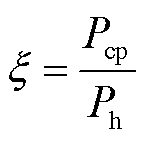
空压机压比 等于空压机出口空气气压与入口空气气压之比,即
 (17)
(17)
压比越大,阴极氧气分压越大。为补充描述不同海拔工况下空压机喘振边界的变化规律,本文采用相关文献中已验证的公式计算各转速下的喘振质量流量[20],即
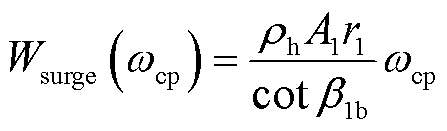 (18)
(18)
式中,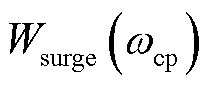 为空压机在转速
 下的喘振边界质量流量。
基于上述空压机多物理场耦合机理,提出机理-数据融合的变海拔特性建模方法:构建数据驱动建模框架,通过序列二次规划(Sequential Quadratic Programming, SQP)算法实现关键参数高精度拟合。模型核心参数与空压机物理结构及气动特性强耦合,基于实验台架空压机实测的40 000~110 000 r/min全工况运行数据,将参数拟合转化为带边界约束的非线性优化问题,采用SQP算法进行全局寻优。基于Matlab Optimization Toolbox中的fmincon函数实现参数自适应校准,最终获得关键参数最优解集。优化问题中目标函数为机理模型气压输出值 和实验数据气压输出值
 的方均根误差,即
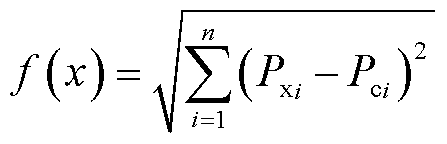 (19)
(19)
待拟合参数集y及最终优化结果为
 (20)
(20)
基于参数拟合结果重构空压机机理模型,图2a所示仿真曲线与地面实验数据的平均相对误差为0.90%(最大相对误差5.62%),验证了构建的离心式空压机模型的准确性。图2a~图2c分别展示了 0、3 000、6 000 m海拔下空压机的全工况MAP曲线及喘振线迁移轨迹。仿真结果表明:当转速范围40 000~110 000 r/min时,空压机最大出口压力随海拔升高呈阶梯式下降,最大压缩空气质量流量缩减率达46%,而空压机最大输出压比x逆向增长至2.87。这是由于海拔上升导致空气密度降低,使得空压机叶轮做功效率下降,安全工作区域缩减,显著影响高空工况下的稳定供气能力。该模型能够为变海拔工况下空气供应系统效率优化及动态特性分析提供可靠的模型基础。
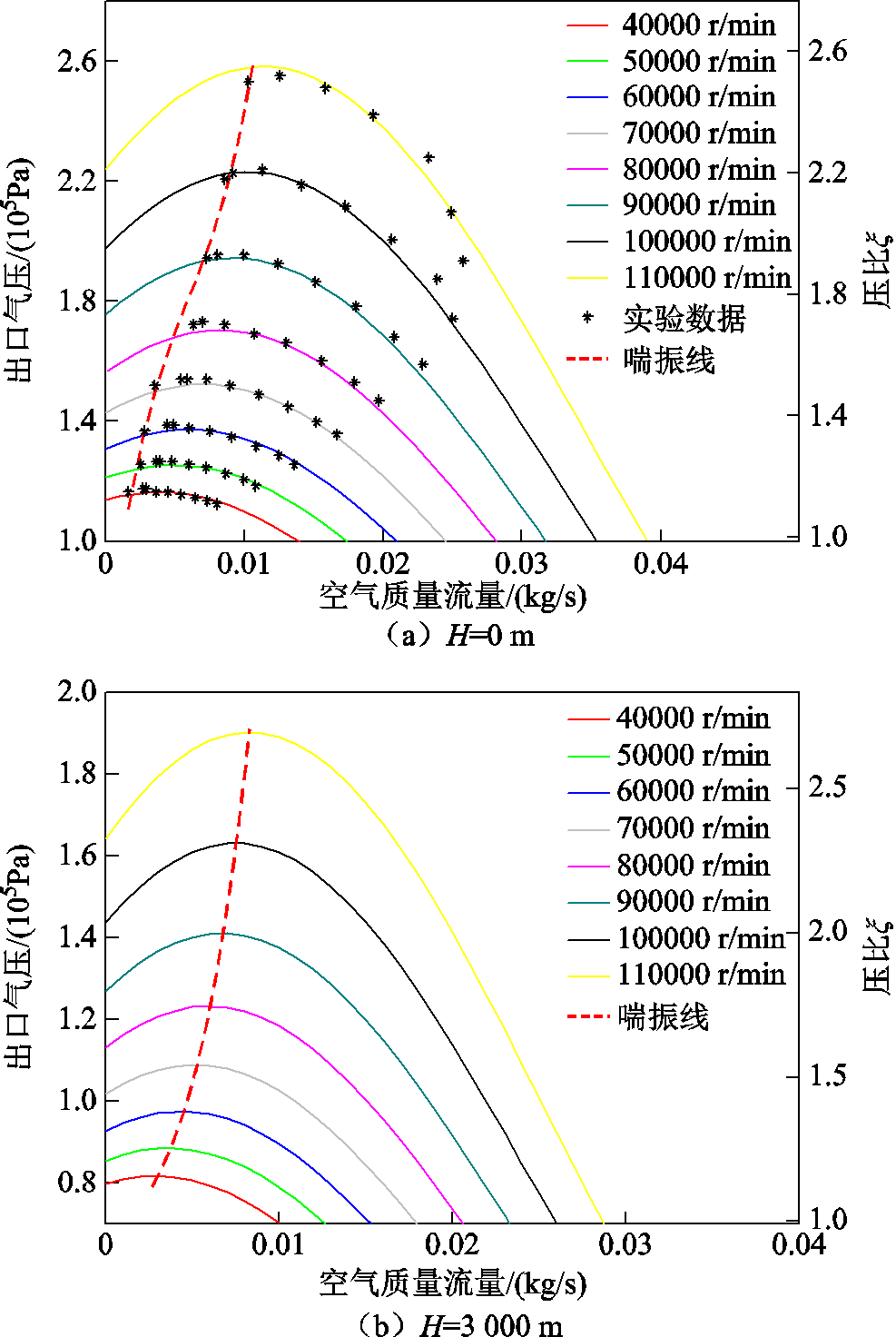
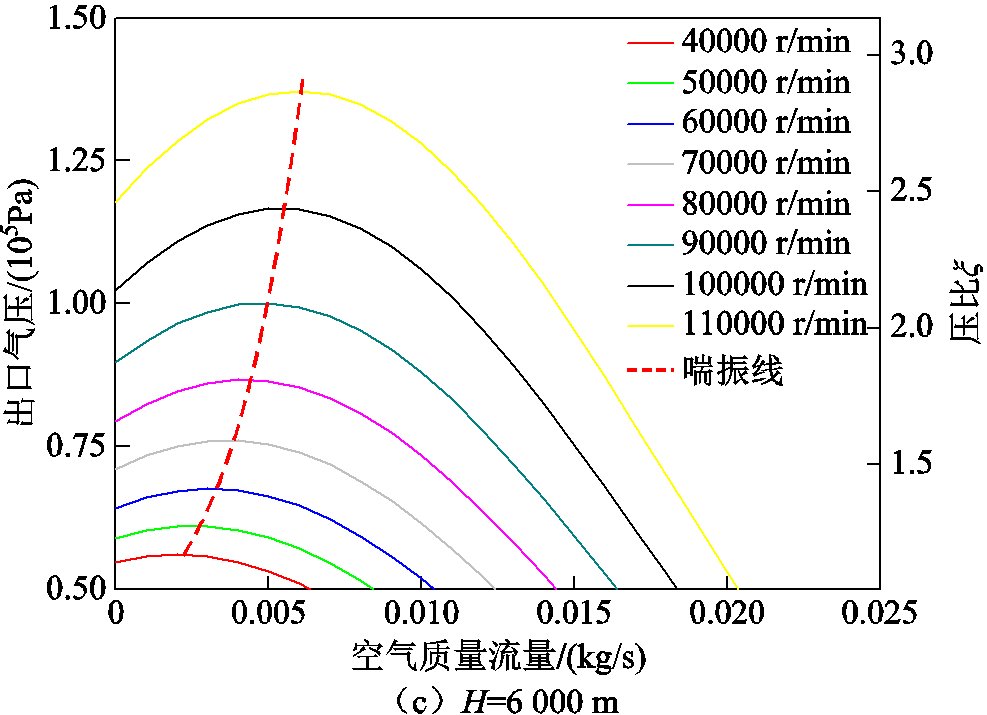
图2 不同高度下空压机MAP图及喘振线变化图
Fig.2 MAP diagram of air compressor and variation of surge line at different heights
1.3.1 供气/排气管道模型
阴极供应歧管的气体流动特征可描述为
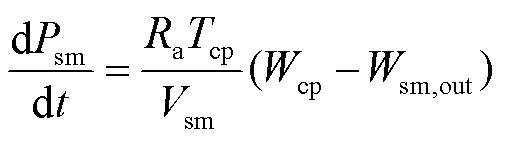 (21)
(21)
 (22)
(22)
式中, 为阴极供应歧管气体压力;
 为空气气体常数;
 为供应歧管温度;
 为供应歧管体积;
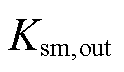 为经验系数;
 为电堆阴极流道压力。
阴极返回歧管的气体流动特征可描述为
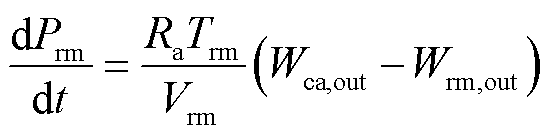 (23)
(23)
式中, 为返回歧管内空气压力;
 为返回歧管内气体温度,数值等于电堆工作温度
 ;
; 为返回歧管体积。
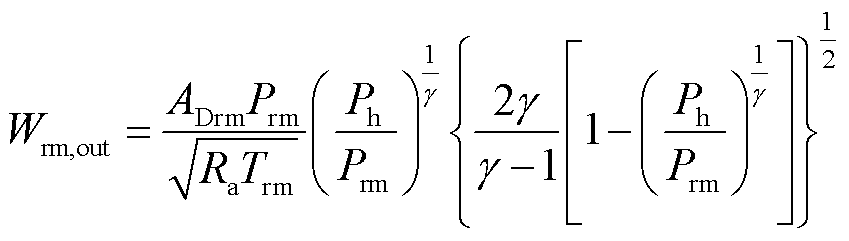
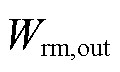 与背压阀门特性、歧管内外压比有如下非线性关系[21]
 (24)
(24)
式中, 为返回歧管末端背压阀门开口面积。
假设阳极气压等于阴极气压Pca,阴极内气体压力特性可描述为
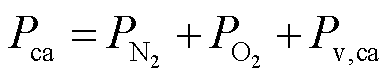 (25)
(25)
式中, 为阴极氮气分压;
 为氧气分压;
 为水蒸气分压。和
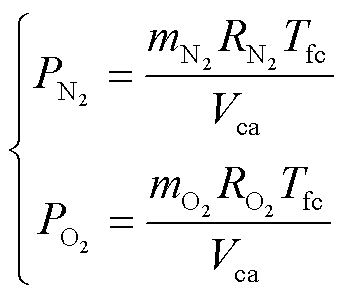
 的计算公式为
 (26)
(26)
式中, 和
和 分别为流道内氮气、氧气质量;
 和
和 分别为氮气、氧气的摩尔质量;
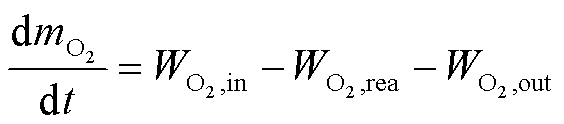
 为阴极流道容积。由式(27)计算。
 (27)
(27)
式中,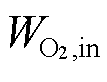 、
、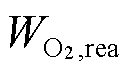 、
、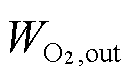 分别为进入阴极流道、反应消耗和未反应排出阴极的氧气质量流量。
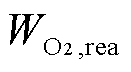 是关于电堆输出电流
 的函数,计算公式为
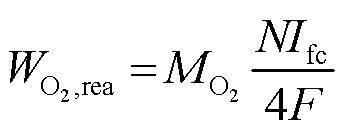 (28)
(28)
式中,F为法拉第常数;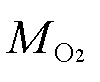 为氧气相对摩尔质量。
过氧比(Oxygen Excess Ratio,OER)用与的比值表示。“氧饥饿”和“氧饱和”都会造成发电系统效率下降,后续优化及仿真中将OER预设为2.0[21],在保证电堆正常运行的同时,提高电堆的输出效率。
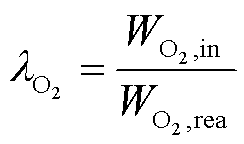 (29)
(29)
PEMFC系统效率受多种参数影响而具有非线性特征,考虑寄生功率损耗与电堆输出性能构建PEMFC系统效率模型,定义为氢气利用率、电堆效率及辅助设备效率三者之积[22],即
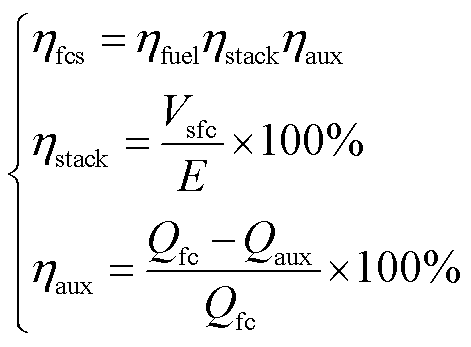 (30)
(30)
式中, 为PEMFC系统效率;
 为PEMFC系统氢气利用率,取100%;
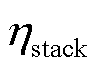 为PEMFC电堆效率;
 为PEMFC辅助设备效率;
 为电堆单体输出电压;
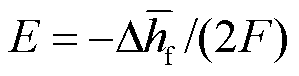 ,其中,
,其中, 为电化学反应的摩尔反应焓变,E值与PEMFC电堆反应热有关,本文中E=1.25[23];
 为PEMFC电堆输出功率;
 为PEMFC的辅助系统消耗的功率,主要包括空压机功率损耗
 、控制器损耗、DC-DC变换器损耗、氢泵损耗、水泵损耗等,假设除空压机以外的寄生损耗和为1 kW。
PEMFC系统效率表达式为
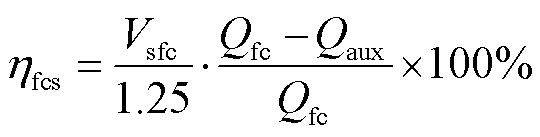 (31)
(31)
当燃料电池阳极气压及阴极水蒸气分压不变,氧气分压从 变成
变成 时,燃料电池的能斯特电势变化量为
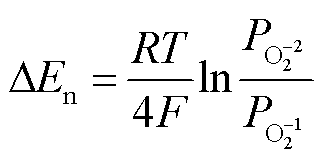 (32)
(32)
该效应被称为氧化剂分压效应[22]。
电池单体输出电压 与电堆输出功率
 表达为
表达为
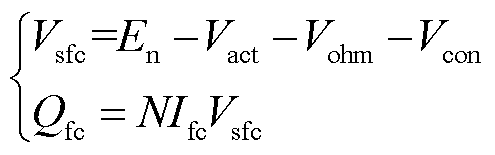 (33)
(33)
式(32)、式(33)表明PEMFC输出电压增量与反应气体压力呈现显著的对数相关性,当氧气分压提升至临界阈值后,电堆电压增幅呈现渐近饱和特性,单位电压增量所需的压力增量呈指数级增长,系统进入能效衰减区。在此工况下,继续增压将引发系统效率的逆向拐点,造成整体能源转换效率的下降。
系统效率变化量为
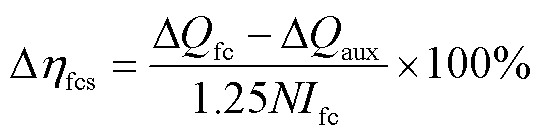 (34)
(34)
若高度和电堆电流不变,当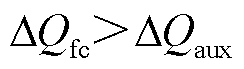 时
时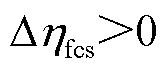 ,
,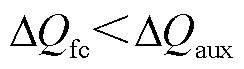 时
时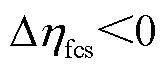 ,当
,当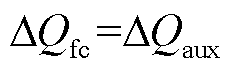 时系统效率有最大值。PEMFC阴极供气系统存在最优压比工作点,通过协同调节空压机转速与背压阀开度实现该压比跟踪时,系统效率可达全局最优。图3揭示了地面环境下负载电流(100~200 A)与压比(1.05~2.20)耦合作用下的效率分布规律:系统效率随压比呈现单峰特性,峰值效率对应的最优压比随电流增大从1.16(100 A)递增至1.72(200 A),动态负载场景需实时优化输出压比以维持高效运行。
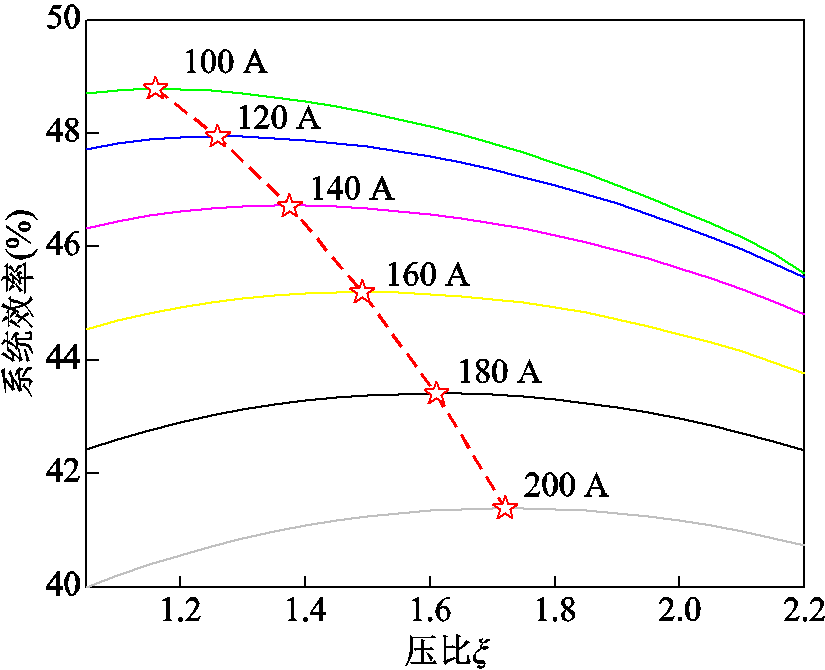
图3 系统效率受压比影响曲线
Fig.3 The influence of system efficiency under pressure ratio
传统低恒定压比策略运行时,系统效率损失主要是由于高海拔供氧不足导致的空压机被动低效运行。海拔较低时,压比无法满足电堆在该电流下的最佳反应需求,限制了电堆的功率输出。海拔升高时大气压力骤降,压比无法补偿压力损失,阴极氧气分压低于反应临界值,PEMFC系统为维持发电量,通过超调空压机转速增加空气流量,功耗增大。高恒定压比策略的核心矛盾是低海拔过增压导致的空压机主动能耗冗余。海拔较低时,大气压力充足,空压机出口压力超过阴极实际需求,寄生功率冗余,超过增压产生的电堆输出性能提升,强制维持高压使空压机流量接近喘振临界值,喘振裕度降低,空压机运行稳定性也降低。
基于系统效率最优的运行压比方案能够提升系统整体效率的根本原因是通过实时匹配工况需求,解决恒定压比高海拔供氧不足和低海拔过增压问题,将空压机运行点集中于高效工作区,在变工况条件下始终维持足够的空气流量,避免低流量-高压力导致的喘振风险。在减小空压机寄生功率的同时,适当的阴极压力提高了阴极侧的氧气分压,氧气传质增强,浓差极化损失减小,单体电池电压提高,在相同的电流下,电堆输出电压和功率提升,实现系统的净输出功率最大化以及系统整体效率的提升,如图4所示。
为确定变海拔工况下PEMFC系统最优压比,采用PSO算法在以下参数空间内进行全局寻优:H∈[0, 6 000]m, ∈[80, 200]A,
 ∈[1.0, 2.5],目标函数为系统效率,如图5所示。
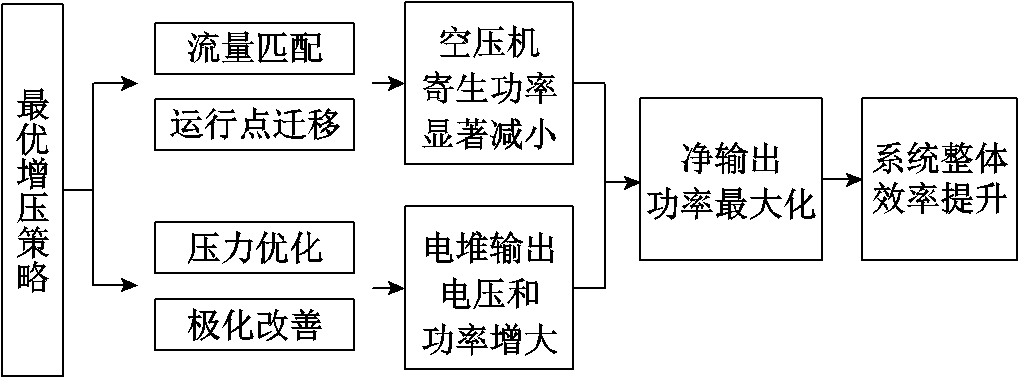
图4 动态压比优化策略的能效提升路径
Fig.4 The energy efficiency improvement path of dynamic pressure ratio optimization strategy
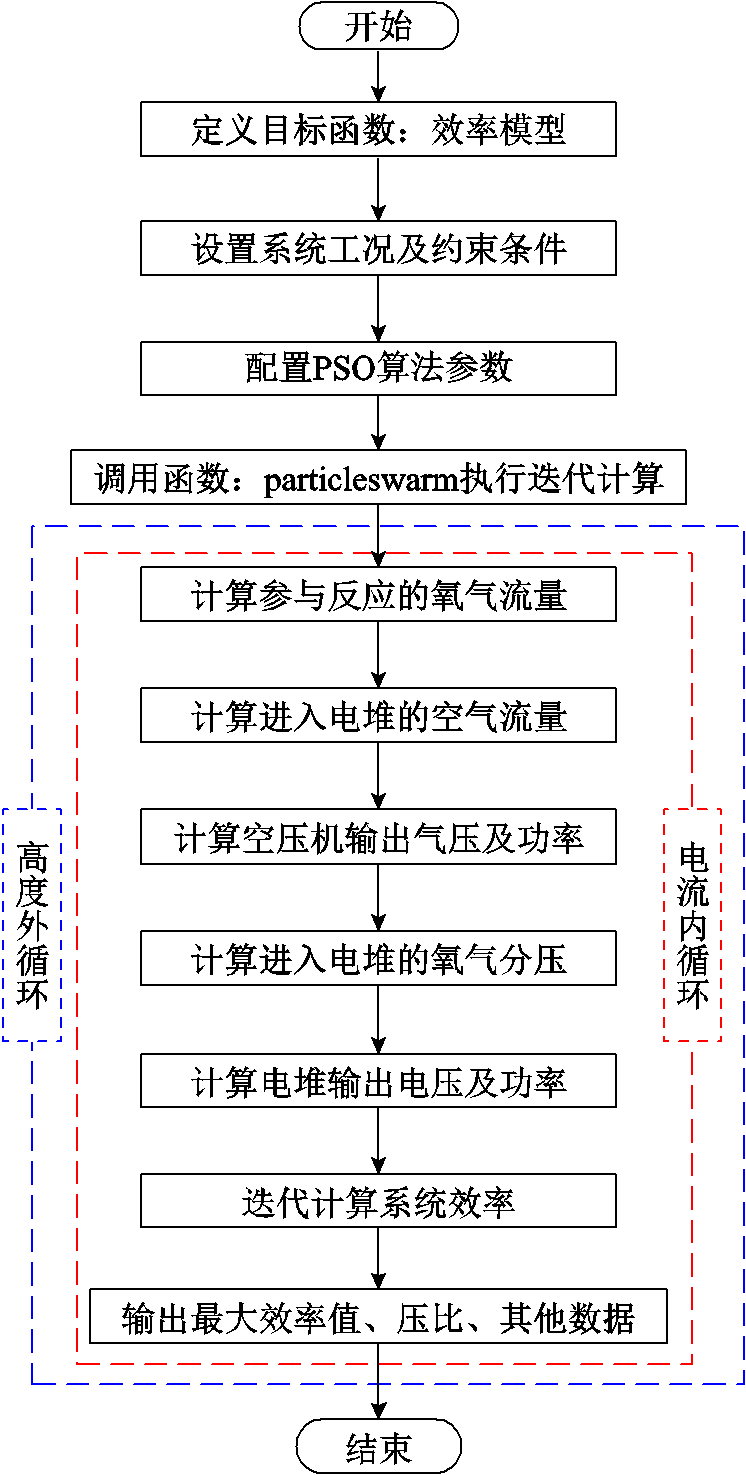
图5 PSO算法最优运行压比计算流程
Fig.5 Flow chart of PSO algorithm for calculating optimal operating pressure ratio
(1)以1.4节建立的系统效率模型为PSO算法的目标函数,引入负号将效率最大化问题转化为算法可解的全局最小值搜索问题,优化过程输入参数为、 、
、 ,通过燃料电池电化学输出特性模型、空压机模型转换为电压、功率形式优化变量,构建PSO最小化目标函数为
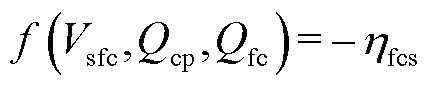 (35)
(35)
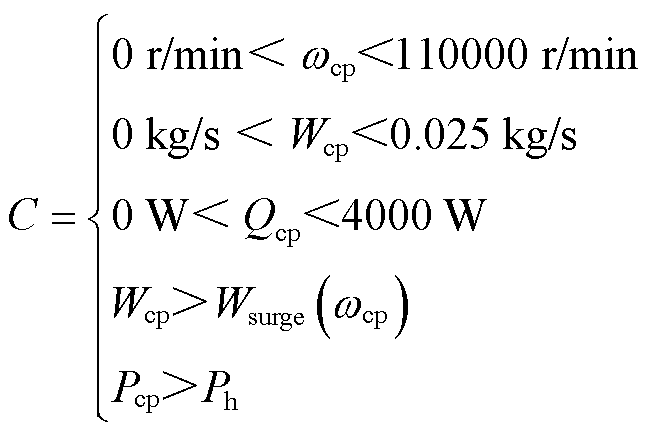
(2)为保障空压机在安全工况区域内运行,建立PEMFC系统动态工况约束框架,并通过引入惩罚项机制规避算法搜索过程中的无效解。系统工况为无人机当前飞行高度和负载电流值(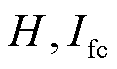 ),初始点为(0 m, 80 A),H的间隔100 m,的间隔5 A,运行约束条件为
 (36)
(36)
(3)采用Matlab内置的particleswarm函数实现PSO算法求解PEMFC系统在不同负载工况下的最优输出压比。固定环境高度H=0 m,负载电流以80 A为起点并循环递增至200 A,在压比范围∈[1.0, 2.5]内对每个工况点进行全局优化,求解系统效率的最大值及其对应的空压机压比最优解。
(4)海拔从0 m递增至100 m,并保持不变,重复执行步骤(3)。
(5)重复执行步骤(4),直至高度循环递增至6 000 m,此时得到海拔0~6 000 m、负载电流80~200 A之间所有工况点对应的最大系统效率及最优运行压比。
(6)绘制() -三维映射图。
基于PSO算法的全局优化结果表明(如图6和图7所示),变海拔工况下PEMFC系统存在显著的最优压缩比动态区间(1.08~2.49),对应的系统最大效率范围为27.46%~49.15%。在低海拔区域,随着高度及负载电流的增加,大气参数减小,最优压比呈近似线性增长,空压机能够满足流量需求;当海拔继续上升,为满足同等流量需求,空压机工作在更高转速,工作效率急剧下降,因最大转速限制,最优压比值随负载电流的增加呈先增后减的非单调特性。进一步分析表明,在空压机等熵效率下降与电堆活化损失增加的综合作用下,系统效率随负载电流与海拔的增大呈现非线性衰减趋势,每升高 1 000 m系统效率平均降幅达3.20%,且海拔越高衰减速率越大,验证了动态最优增压策略在变海拔工况下的必要性。
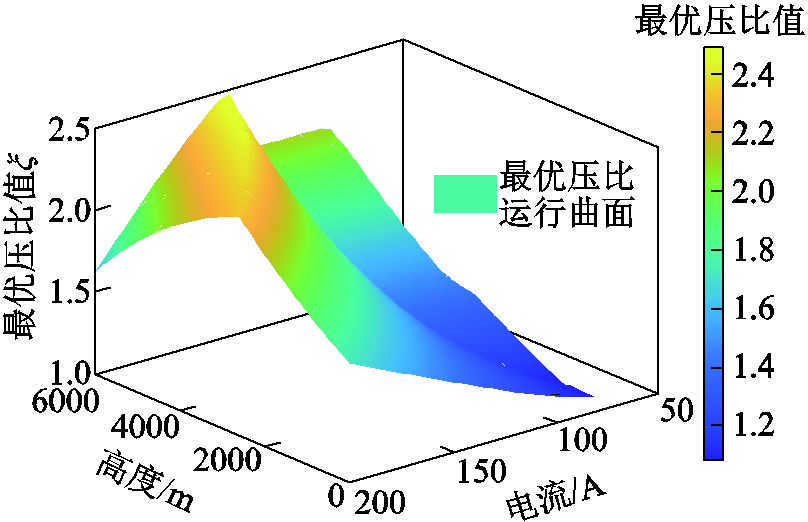
图6 最优运行压比曲面
Fig.6 Optimal operating pressure ratio surface
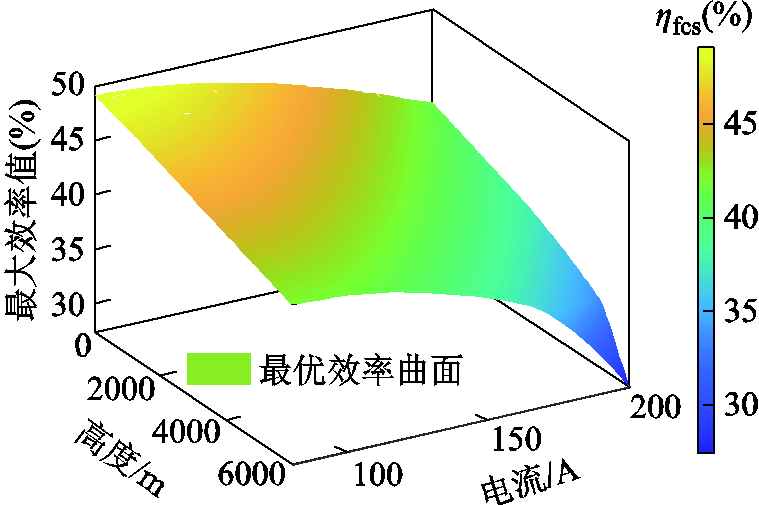
图7 运行在最优压比时的系统效率曲面
Fig.7 Efficiency surface of the system running at the optimal pressure ratio
为验证动态增压策略按需匹配压比的优越性,研究设置三组恒定增压供气方式,对比分析不同增压方案下的燃料电池系统输出性能。结合燃料电池阴极反应需求、空压机压缩特性以及变海拔环境适配性,恒定增压比设为 =1.2、1.6、2.0,以呈现压比变化对系统效率的影响规律,仿真结果如图8所示。相较于传统恒定压缩比策略,PSO动态增压方案在全工况范围内效率提升显著,最大提升31.50%、10.50%、6.83%,平均提升5.62%、1.53%、0.91%。效率优化效果呈现典型工况依赖性:在高海拔及大电流区域(H≥2 800 m,
 ≥140 A),PSO相比1.2倍和1.6倍恒定增压提升效果明显,PSO通过动态调节压缩比(1.63~2.49),在空压机转速饱和条件下优先保障临界氧流量,避免因空气稀薄引发的阴极饥饿,效率较=1.2、1.6策略分别提升3.35%~31.50%、0.07%~10.50%;低海拔小电流区域(H<2 800 m,<140 A),PSO相比2.0倍恒定增压提升效果更为明显,动态优化将压缩比降至1.08~1.69,效率提升0.25%~6.83%。
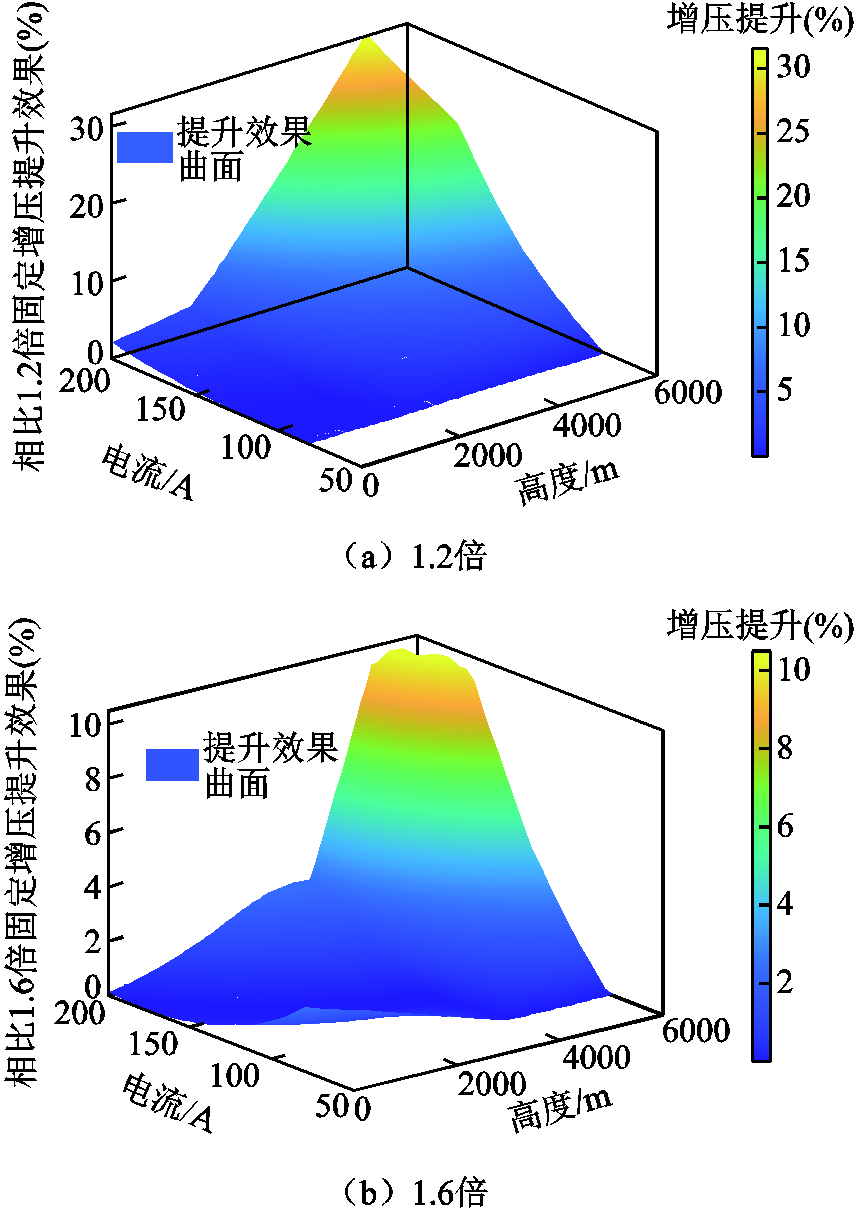
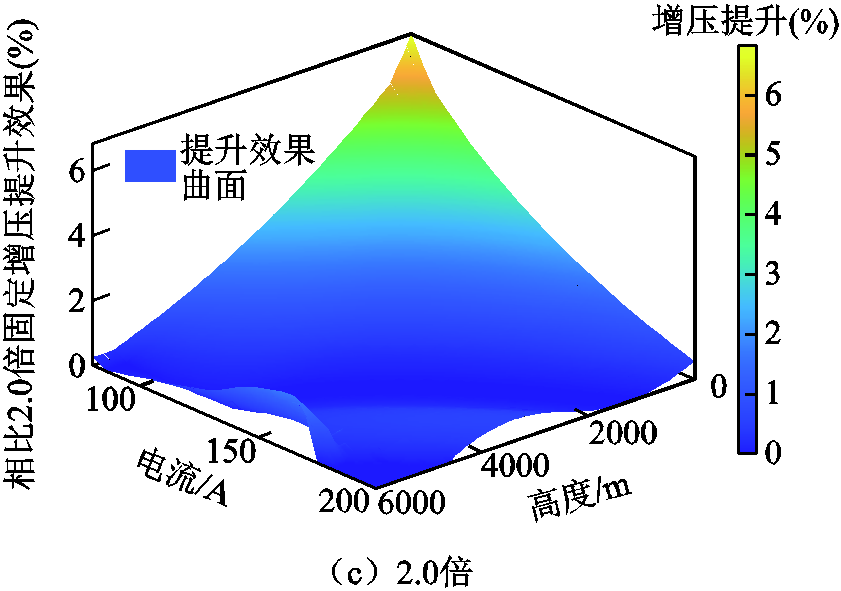
图8 最优方案相比1.2倍、1.6倍、2.0倍恒定增压方案提升效果曲面
Fig.8 Surface of the boosting effect of the optimal scheme compared to the 1.2×, 1.6×, and 2.0× fixed schemes
通过查表法将(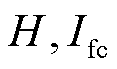 ) -导入PEMFC阴极供气系统的仿真模型中,降低实时计算复杂度。无人机飞行过程中海拔
 和负载电流
和负载电流 是两个重要的动态变化参数,对无人机的飞行状态产生显著影响,将二者作为扰动输入能更真实地模拟无人机飞行情况。系统实时搜索离线数据表,将最优压比和流量作为参考值输送给控制器,采用这种精确查找实现对无人机飞行状态的快速调节,从而使其工作在预期的最大效率。供气系统中流量和压力具有强耦合作用,通过设计PID双闭环控制器,动态补偿压比偏差,适应环境变化,实现阀门控制PEMFC系统阴极入口压力、空压机控制过氧比,整体仿真结构如图9所示。
文献[24]为无人机飞行任务剖面设计提供了参考,如图10所示。剖面分别对应无人机滑行(0~8 s)、爬升(8~108 s)、巡航(108~128 s)、下降(128~165.5 s)、再次巡航(165.5~170s)五个关键阶段,各阶段需求功率分别为6、8、4、3、4 kW。
3.2节无人机功率需求转换为电堆输出端负载电流变化如图11所示。

图9 基于PSO算法最优增压策略运行结构
Fig.9 The operation structure of the optimal boosting strategy based on the PSO algorithm
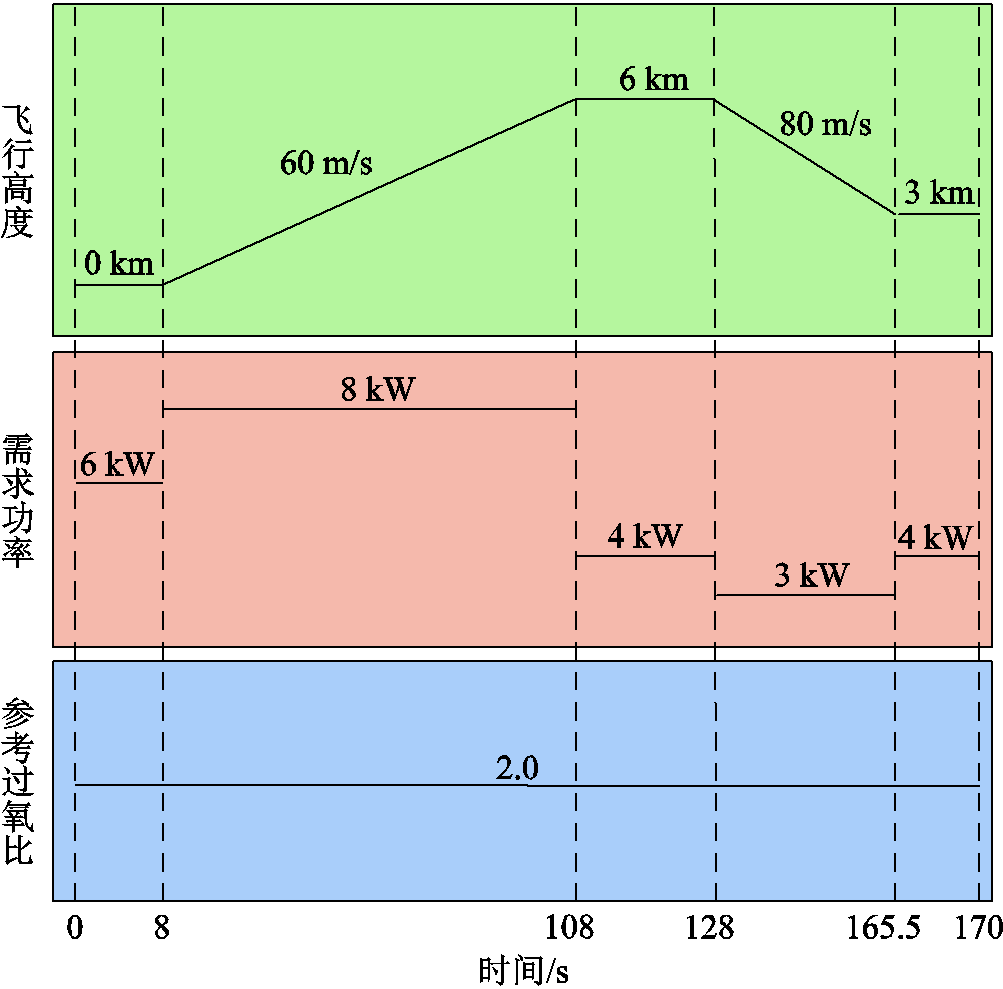
图10 无人机飞行任务设定
Fig.10 Unmanned aerial vehicle (UAV) mission planning
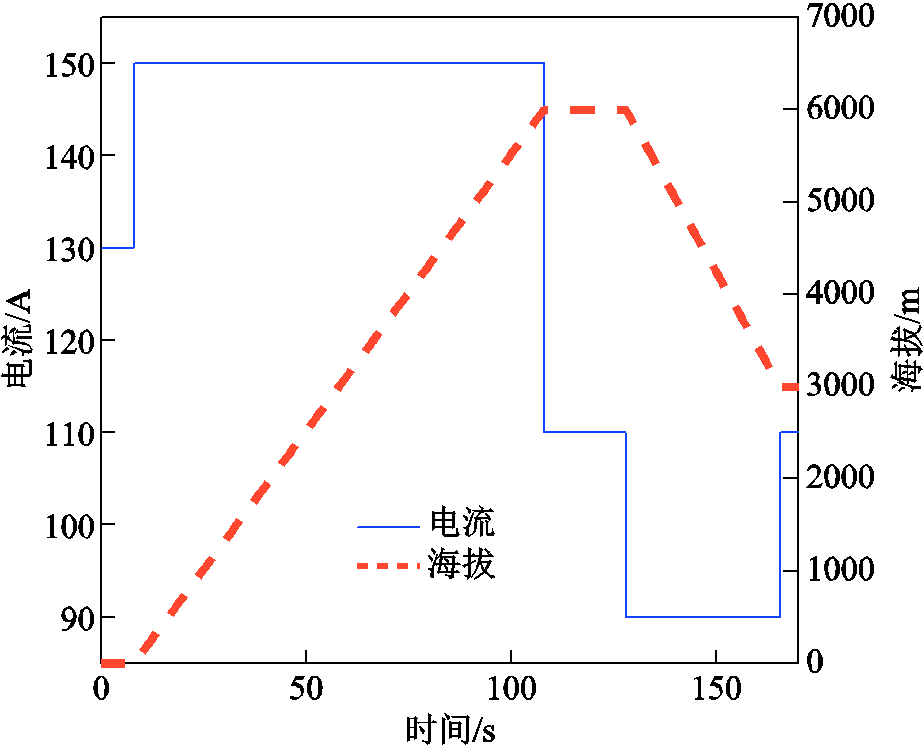
图11 无人机所处高度及负载电流需求
Fig.11 The altitude at which the unmanned aerial vehicle is located and the load current requirements
在仿真170 s过程中,双PID闭环控制器对OER和 的整体控制效果较好,最优压比始终保持稳定追踪状态,控制器鲁棒性强,各状态量动态变化过程如图12所示。系统在初始滑行阶段,控制器控制阀门打开并迅速提升空压机转速,2.2 s内实现了OER和压比跟踪,由于空压机直接控制空气流量,该控制过程导致OER出现2.50%的正向超调。在系统运行至第8 s时开始爬升,负载电流发生130 A至150 A的阶跃变化,触发流量及压比参考值同步提升。动态响应过程中,空压机转速与阀门开度呈现瞬时突变特性,引发过氧比出现3.15%的负向超调。随着系统运行海拔的持续抬升,大气环境的空气密度、进气压力、温度等参数不断下降,为应对进气条件变化,控制器控制系统将压比参考值动态上调,驱动空压机持续提升运行转速,在满足压比控制要求的同时,有效维持了过氧比的稳定(稳态误差<±0.05%)。在调控过程中,阀门开度基本维持不变,通过转速调节实现双参数协调控制。90 s时空压机转速达到极限值110 000 r/min,面对继续上升的高度,参考压比下降,阀门迅速增加开度稳定过氧比。第108 s系统进入巡航状态,负载电流骤降至110 A,空压机转速降至96 460 r/min,阀门开度锁定使过氧比3 s内恢复至2.0。第128 s无人机下降,负载电流减小至90 A,空压机转速随之降低即能保持流量要求,压比参考值随高度下降而减小,阀门开度较之前减小并在之后略微上升以调整气压。第165.5 s无人机再次巡航,负载电流回弹至110 A时,转速-阀门协同策略使系统在1.7 s内完成OER跟踪。
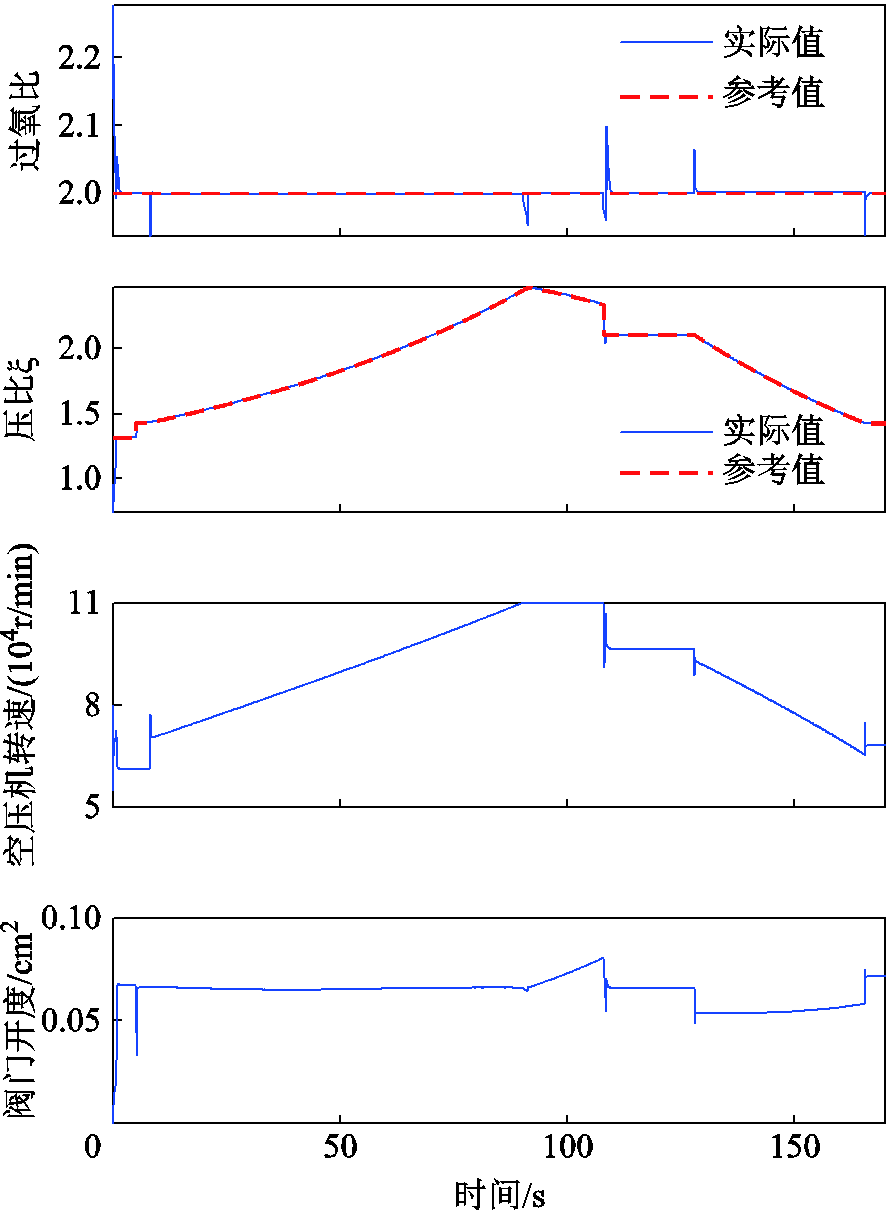
图12 最优策略双PID闭环控制仿真结果
Fig.12 Simulation results of optimal strategy double PID closed-loop control
电堆输出功率、PEMFC系统净输出功率、空压机寄生损耗功率以及其他损耗功率如图13所示。在无人机整个飞行任务过程中,PEMFC系统能够在满足任务需求功率的同时,减少空压机寄生损耗,维持相对稳定的净功率输出。图14中,PSO最优压比运行策略始终保持系统最高效率值输出,在海拔及负载扰动下,相比1.2倍、1.6倍、2.0倍恒定增压策略,最大提升分别为11.78%、7.60%、2.80%,平均提升分别为4.03%、1.38%、0.91%,验证了所提策略的有效性和PID双闭环控制架构在负载突变下的动态协调能力。
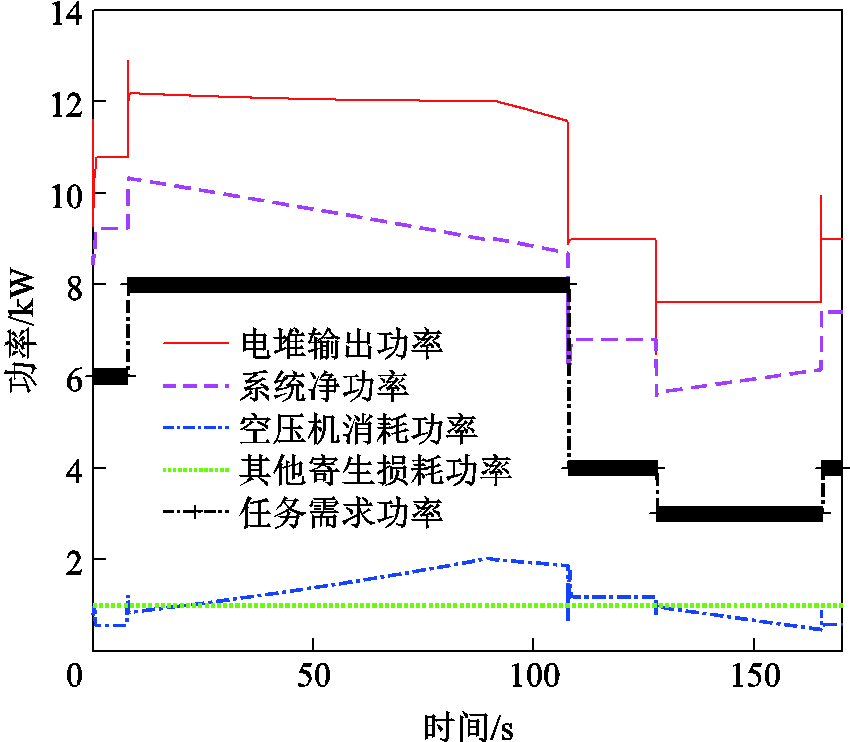
图13 最优增压策略下各部分功耗
Fig.13 Power consumption of each part under the optimal boosting strategy
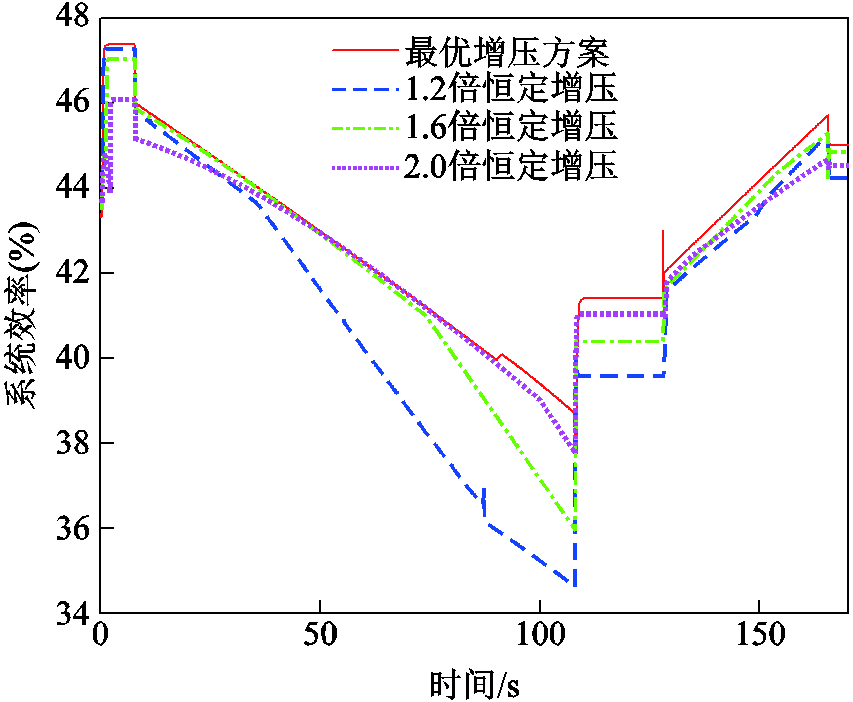
图14 最优增压策略与恒定增压策略系统效率对比
Fig.14 Comparison of system efficiency between optimal booster strategy and fixed booster strategy
图15呈现了动态压比优化策略下空压机在变海拔工况(0、2 000、4 000、6 000 m)的喘振运行迹线,随海拔升高向左上方偏移,所有工况点均位于对应海拔喘振线的右侧安全区域,与喘振线接近但保持动态安全裕度(流量裕度≥0.002 kg/s,压比裕度≥0.1),对变海拔工况具有强适应性。运行点集中分布在压比1.2~2.4、流量0.007~0.013 kg/s的区间内,将空压机持续控制在高效工作区。
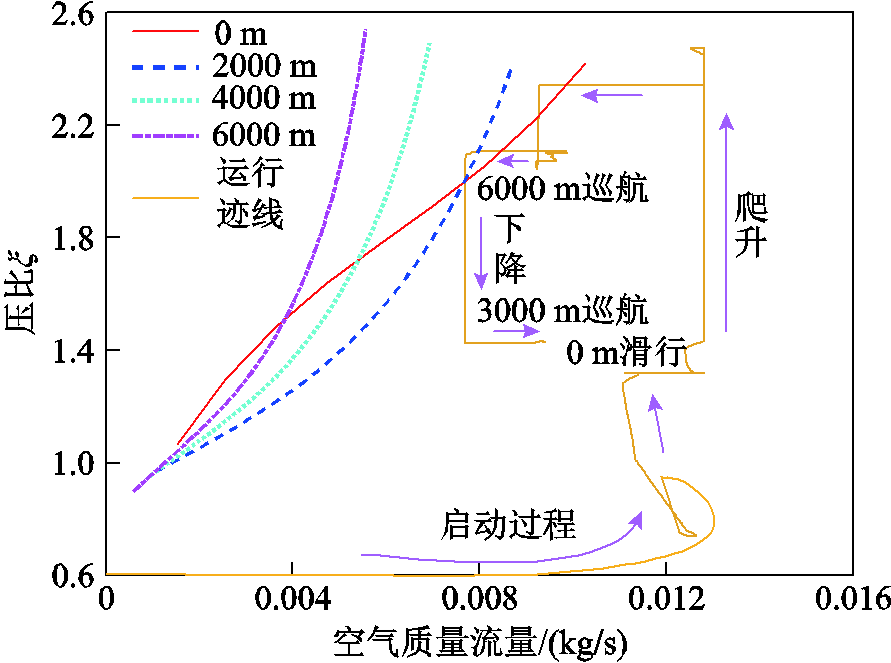
图15 最优增压策略下空压机运行迹线
Fig.15 The operating trajectory of the air compressor under the optimal supercharging strategy
针对高空复杂工况下PEMFC系统效率下降问题,本文提出了一种基于PSO算法的最优增压比供气策略。该方法通过构建离线计算-实时搜索的运行架构,将系统效率模型作为PSO优化目标,获得静态工作点最优压比。动态工况下,通过PID双闭环控制器快速有效地使系统运行在最优点,提高系统效率。该方法在实际空压机安全运行范围下,与传统恒定压运行策略进行仿真对比,证明了其有效性,得出了以下结论:
1)PEMFC系统运行效率与反应气体压力呈单峰值函数特性,理论分析与仿真验证表明,在特定飞行高度与负载条件下,存在全局最优的空压机输出压力值,当调控空压机转速与背压阀开度使气体压力稳定于该最优值时,系统可维持最大效率运行。
2)针对宽工况动态响应的工程需求,研究提出的基于PSO算法的动态增压调控策略,相比1.2、1.6、2.0倍恒定增压方法在不同的工况区域提升效果不同,全工况平均提升效果分别为5.62%、1.53%、0.91%。仿真结果表明,在飞行任务过程中实时更新最优压比参考值,系统能快速在最高效率点稳定运行,相比恒定增压策略平均提升4.03%、1.38%、0.91%,研究结果突破了传统阴极供气控制研究的静态局限性,为提升燃料电池动力无人机续航里程提供了可参考的工程化解决方案。
参考文献
[1] 邹卓岩. 氢燃料电池在无人机领域的应用分析[J]. 工程与管理科学, 2023, 5(3): 122-124. Zou Zhuoyan. Application analysis of hydrogen fuel cell in UAV[J]. Engineering and Management Science, 2023, 5(3): 122-124.
[2] 姬志行. 基于燃料电池的长航时无人机推进系统性能研究[D]. 哈尔滨: 哈尔滨工业大学, 2021. Ji Zhixing. Performance investigation of fuel cell propulsion systems on unmanned aerial vehicles with long endurance[D]. Harbin: Harbin Institute of Technology, 2021.
[3] 赵冬冬, 赵国胜, 夏磊, 等. 无人机用燃料电池阴极供气系统建模与控制[J]. 航空学报, 2021, 42(7): 496-512. Zhao Dongdong, Zhao Guosheng, Xia Lei, et al. Modeling and control of fuel cell cathode gas supply system for UAV[J]. Acta Aeronautica et Astronautica Sinica, 2021, 42(7): 496-512.
[4] Chen Xi, Gu Bin, Feng Wentao, et al. Research on control strategy of PEMFC air supply system for power and efficiency improvement[J]. Energy, 2024, 304: 132100.
[5] Chen Jinzhou, He Hongwen. Improve hydrogen economy for vehicular fuel cell system via investigation and control of optimal operating oxygen excess ratio[J]. Energy Reports, 2022, 8: 5883-5897.
[6] Schröter J, Graf T, Frank D, et al. Influence of pressure losses on compressor performance in a pressurized fuel cell air supply system for airplane applications[J]. International Journal of Hydrogen Energy, 2021, 46(40): 21151-21159.
[7] Jiang Feifan, Wei Zhongbao, Zhang Caizhi, et al. Cathodic supply optimization of PEMFC system under variable altitude[J]. IEEE Transactions on Industrial Electronics, 2024, 71(11): 14298-14307.
[8] Zhao Dongdong, Hua Zhiguang, Dou Manfeng, et al. Control oriented modeling and analysis of centrifugal compressor working characteristic at variable altitude[J]. Aerospace Science and Technology, 2018, 72: 174-182.
[9] Li Shuo, Qiu Yibin, Yin Liangzhen, et al. Net power optimization based on extremum search and model-free adaptive control of PEMFC power generation system for high altitude[J]. IEEE Transactions on Transportation Electrification, 2023, 9(4): 5151-5164.
[10] Xie Shuqi, Li Qi, Yin Liangzhen. Net power enhancement of proton exchange membrane fuel cell system under variable altitude conditions[C]//2024 IEEE Transportation Electrification Conference and Expo, Asia-Pacific (ITEC Asia-Pacific), Xi’an, China, 2024: 95-100.
[11] Liu Yu, Kong Hongbing, Tang Gang. Efficiency optimization control of the proton exchange membrane fuel cell system under variable altitude condition[C]//2024 7th Asia Conference on Energy and Electrical Engineering (ACEEE), Chengdu, China, 2024: 327-333.
[12] 戚志东, 裴进, 胡迪. 基于分数阶PID控制的质子交换膜燃料电池前级功率变换器[J]. 电工技术学报, 2019, 34(增刊1): 235-243. Qi Zhidong, Pei Jin, Hu Di. Pre-stage power converter of proton exchange membrane fuel cell based on fractional order PID controller[J]. Transactions of China Electrotechnical Society, 2019, 34(S1): 235-243.
[13] Sun Tian, Zhang Xin, Chen Bin, et al. Coordination control strategy for the air management of heavy vehicle fuel cell engine[J]. International Journal of Hydrogen Energy, 2020, 45(39): 20360-20368.
[14] 王天宏, 李奇, 尹良震, 等. 燃料电池系统在线辨识和实时最大效率滑模控制方法[J]. 中国电机工程学报, 2019, 39(17): 5118-5128. Wang Tianhong, Li Qi, Yin Liangzhen, et al. Fuel cell system online identification and real-time maximum efficiency sliding mode control method[J]. Proceedings of the CSEE, 2019, 39(17): 5118-5128.
[15] Yin Liangzhen, Li Qi, Breaz E, et al. Model guided extremum seeking and active disturbance rejection control for efficiency real-time optimization of PEMFC system[J]. IEEE Transactions on Industrial Electronics, 2024, 71(6): 5905-5919.
[16] Wang Yuhang, Li Haotian, Feng Huimin, et al. Simulation study on the PEMFC oxygen starvation based on the coupling algorithm of model predictive control and PID[J]. Energy Conversion and Management, 2021, 249: 114851.
[17] AbouOmar M S, Zhang Huajun, Su Yixin. Fractional order fuzzy PID control of automotive PEM fuel cell air feed system using neural network optimization algorithm[J]. Energies, 2019, 12(8): 1435.
[18] Li Jiawen, Yu Tao, Yang Bo. Coordinated control of gas supply system in PEMFC based on multi-agent deep reinforcement learning[J]. International Journal of Hydrogen Energy, 2021, 46(68): 33899-33914.
[19] Pukrushpan J T, Peng Huei, Stefanopoulou A G. Control-oriented modeling and analysis for automotive fuel cell systems[J]. Journal of Dynamic Systems, Measurement, and Control, 2004, 126(1): 14-25.
[20] Xie Shuqi, Li Qi, Yin Liangzhen, et al. Multivariable cooperative control for performance guarantee of PEMFC system in high-altitude environment[J]. IEEE Transactions on Industrial Electronics, 2024, 71(12): 15846-15857.
[21] Zhao Dongdong, Xia Lei, Dang Hanbin, et al. Design and control of air supply system for PEMFC UAV based on dynamic decoupling strategy[J]. Energy Conversion and Management, 2022, 253: 115159.
[22] 朱亚男, 李奇, 黄文强, 等. 基于功率自适应分配的多堆燃料电池系统效率协调优化控制[J]. 中国电机工程学报, 2019, 39(6): 1714-1722. Zhu Yanan, Li Qi, Huang Wenqiang, et al. Efficiency coordination and optimization control method of multi-stack fuel cell systems based on power adaptive allocation[J]. Proceedings of the CSEE, 2019, 39(6): 1714-1722.
[23] 黄镇江. 燃料电池及其应用[M]. 北京: 电子工业出版社, 2005.
[24] 张晓辉, 刘莉, 戴月领, 等. 燃料电池无人机动力系统方案设计与试验[J]. 航空学报, 2018, 39(8): 157-166. Zhang Xiaohui, Liu Li, Dai Yueling, et al. Design and test of propulsion system for fuel cell powered UAVs[J]. Acta Aeronautica et Astronautica Sinica, 2018, 39(8): 157-166.
Abstract In complex operating environments, the power generation system of fuel cell unmanned aerial vehicles (UAVs) encounters challenges, including insufficient oxygen supply at high altitudes and reduced overall system efficiency. To address these issues, a dynamic pressure ratio control strategy for the air compressor based on the particle swarm optimization (PSO) algorithm is proposed. A multi-parameter coupled system efficiency model is employed as the optimization objective function to achieve comprehensive efficiency enhancement.
Firstly, a voltage output characteristic model of the proton exchange membrane fuel cell stack, a supply and exhaust pipeline model, and a system efficiency model are established. For the centrifugal air compressor under variable altitude conditions, a hybrid modeling approach combining mechanistic principles with data-driven techniques is developed. This method constructs a data-driven framework by transforming parameter identification into a nonlinear optimization problem subject to boundary constraints, solved efficiently using the sequential quadratic programming (SQP) algorithm. The optimized parameters are then integrated into the mechanistic model. Validation results demonstrate strong agreement between the hybrid compressor model and experimental data, with an average relative error of approximately 0.90% and a maximum relative error of 5.62%. As altitude increases, the compressor’s maximum outlet flow rate and pressure decrease, while the maximum pressure ratio increases, leading to a narrowed operational range and a leftward shift of the surge line. According to gas partial pressure theory, the efficiency of the fuel cell system exhibits a unimodal relationship with reactant gas pressure. By adjusting the compressor speed and back-pressure valve opening, the system can maintain gas pressure at this optimal level, thereby maximizing efficiency.
To meet engineering requirements for rapid dynamic response across a wide operating range, the PSO algorithm is used to design a dynamic pressure ratio control strategy. This strategy designed with the multi-parameter coupled system efficiency model as the objective function, with UAV altitude and load current serving as disturbance inputs. Within the dynamic operational constraints of the compressor, the optimal pressure ratios are computed over an altitude range of 0~6 000 meters and a load current range of 80~200 A using Matlab’s built-in particleswarm function. A penalty term is incorporated into the optimization process to eliminate infeasible solutions and ensure convergence toward global optimality. The proposed strategy achieves average efficiency improvements of 5.62%, 1.53%, and 0.91% compared to conventional constant boost ratio strategies (1.2×, 1.6×, and 2.0×, respectively). Through dynamic compensation within a PID dual-loop control structure, cathode-side gas parameters rapidly converge to the optimal operating point. Simulations confirm that the proposed strategy consistently maintains peak system efficiency and outperforms alternative approaches under varying environmental and load conditions. The compressor's operating trajectory under variable altitudes remains within the safe region to the right of the surge line, closely approaching it while maintaining adequate margins (flow margin≥0.002 kg/s, pressure ratio margin≥0.1). Thus, the compressor operates continuously within its high-efficiency zone, achieving simultaneous “surge risk mitigation” and “efficient operating range retention”.
The following conclusions can be drawn from the simulation analysis: (1) Under specific flight altitude and load conditions, there exists a globally optimal output pressure value for the air compressor that enables the system to operate at maximum efficiency. (2) The proposed strategy avoids the surge risk caused by the low flow rate and high pressure of the air compressor. (3) The proposed strategy can enhance the flight stability and endurance of unmanned aerial vehicles in high-altitude environments compared to the constant boost method.
keywords:Proton exchange membrane fuel cell, particle swarm optimization, system efficiency, cathode gas supply system, proportional-integral-derivative (PID)
DOI: 10.19595/j.cnki.1000-6753.tces.251474
中图分类号:TM911
国家自然科学基金(52277226)和陕西省重点研发计划(2024GX-YBXM-266)资助项目。
收稿日期 2025-08-21
改稿日期 2025-10-11
朱丹丹 女,1998年生,硕士研究生,研究方向为燃料电池空气供应系统优化与控制策略。E-mail:zhudandan@mail.nwpu.edu.cn
赵冬冬 男,1985年生,教授,博士生导师,研究方向为燃料电池动力系统、航空航天电机驱动等。E-mail:zhaodong@nwpu.edu.cn(通信作者)
(编辑 郭丽军)